How to Praise Kids: Why "Good Job" Backfires and What to Say Instead
Praise is powerful, which is exactly why the wording matters. Small changes in what you say can help your child love effort, not fear failure.
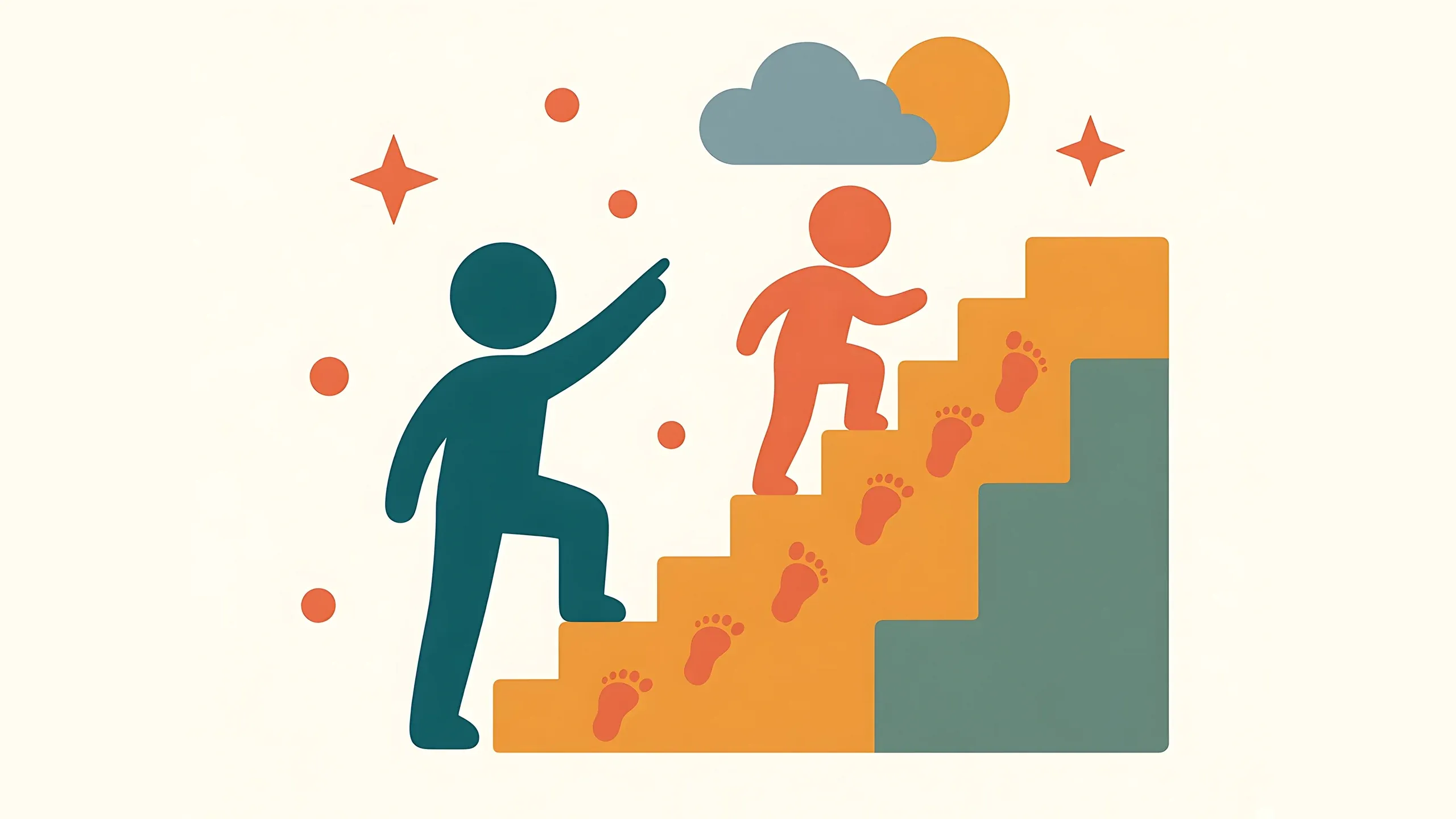
The most helpful praise describes what your child did, not who your child is. "You kept trying different pieces until it fitted" teaches persistence. "You're so clever" teaches that cleverness is something you either have or don't, and that mistakes might reveal you don't.
Try tonight: the 60-second version
- Swap one label for one description. Instead of "Clever girl!", try "You worked out that the big blocks go at the bottom."
- Ask a question instead of judging. "How did you make the sky so stormy?"
- Praise the process when it's hard, not only when it's finished: "That's tricky, and you're still going."
- Tell one family story at dinner about a time you got something wrong and kept trying.
What the research actually says
In a series of classic experiments, psychologists Claudia Mueller and Carol Dweck gave children a set of puzzles, then praised them in one of two ways: for their intelligence ("You must be smart at this") or for their effort ("You must have worked hard"). Then they gave everyone a much harder set.
The children praised for intelligence were more likely to choose easy tasks afterwards, enjoyed the hard problems less, performed worse after the setback and were even more likely to exaggerate their scores to others. The effort-praised children kept going.
A related study by Melissa Kamins and Dweck found the same pattern in younger children: praise aimed at the person ("You're a good drawer") left children more helpless after a mistake than praise aimed at the process ("You found a good way to do it").
And it starts early. Elizabeth Gunderson and colleagues recorded parents at home with their toddlers. The more process praise toddlers heard between ages one and three, the more likely they were, at seven or eight, to believe that abilities grow with effort and to prefer challenges.
A big review by Jennifer Henderlong and Mark Lepper adds nuance: praise helps motivation when it is sincere, specific, focused on things children control, and free of comparisons with others.
Say this instead of that
| Instead of… | Try… |
|---|---|
| "You're so smart!" | "You kept thinking until you found the answer." |
| "Good job!" (on repeat) | "You put the cups away without being asked. That really helped me." |
| "You're a natural." | "All that practice is paying off. Your kicks are much stronger." |
| "That's the most amazing drawing ever!" | "Tell me about the colours you chose." |
| "Better than your brother!" | "You did more pages than last week." |
| "Don't worry, maths just isn't your thing." | "Maths is hard right now. What could you try next?" |
Age by age: praise that fits
| Age | What lands best | Example |
|---|---|---|
| Toddler (1–3) | Describing actions out loud, smiling, shared delight | "You climbed up all by yourself!" |
| Preschool (3–5) | Effort and strategy, plus curious questions | "You tried three ways to make it balance." |
| School age (6–9) | Specific progress, persistence, kindness to others | "Last month this word was hard. Now you read it easily." |
| Tweens (10–12) | Low-key, private, sincere; recognising choices and values | "I noticed you helped your friend even though you were busy." |
Older children are very good at spotting empty praise. With tweens, a quiet "I saw that" often means more than a cheer.
Myth vs fact
- Myth: More praise means more self-esteem. Fact: Inflated praise can backfire, especially for children who already doubt themselves (Brummelman and colleagues, 2014).
- Myth: Process praise just means saying "you tried hard". Fact: It covers strategies, choices, focus, progress and asking for help, not only effort.
- Myth: Praising intelligence motivates kids to live up to it. Fact: It can make them protect the label by avoiding anything they might fail at.
- Myth: Growth mindset means every outcome is fine. Fact: Honest feedback still matters. Children need to hear what isn't working yet, and what to try next.
One afternoon, step by step
Sami (6) brings you a drawing of a dragon. Your instinct is "Wow, beautiful!" Here's another way:
- Stop and look. Really look, for three full seconds. Children notice when you glance.
- Describe what you see. "The dragon's wings go all the way to the edges of the paper."
- Ask about his process. "How did you make the fire look so bright?" Sami explains he pressed hard with the orange crayon and added yellow on top.
- Name the strategy. "Layering colours. That's what artists do."
- Leave room for his own judgement. "Which part are you proudest of?" He points to the tail. You smile: "Tell me why."
Sami walks away taller, not because you said "beautiful", but because you were curious about his thinking.
Your praise checklist
- ☐ I describe what I see more often than I label my child
- ☐ I praise strategies, choices and progress, not only results
- ☐ I avoid comparisons with siblings or classmates
- ☐ I keep praise sincere and proportionate
- ☐ I ask "How did you do it?" at least once a day
- ☐ I share my own mistakes and what I learned
- ☐ I let my child evaluate their own work first
If this doesn't work
- It feels awkward and scripted. That's normal for the first few weeks. Pick one phrase and use it until it feels like yours.
- Your child asks "But is it good?" Answer honestly and warmly, then turn it back: "I like the colours. What do you like about it?"
- Your child still melts down over mistakes. Praise is only one piece. Read our guide to building resilience after mistakes for the rest.
- Your child only works for praise or rewards. Step back from big reactions for a while and focus on interest and shared fun, as in learning through play.
Where this fits in everyday life
Process praise is easiest to practise in daily routines: helping at home (see chores by age), getting dressed independently (see self-care skills by age) and following curiosity (see how to encourage curiosity). Reading together is another natural moment, as in reading aloud by age.
Bedtime helpers
The Snail Who Took the Long Way celebrates slow, steady progress, and The Star Who Wanted to Be First is a gentle story about letting go of always being the best. Both open the door to talking about effort without a lecture.
Frequently asked questions
Is it bad to tell my child they are smart?
It is not harmful once in a while, but a steady diet of 'You're so smart' can teach children that ability is fixed. In Mueller and Dweck's studies, children praised for intelligence later avoided challenges and coped worse with failure than children praised for effort.
Should I stop saying 'good job' completely?
No need to police every word. 'Good job' is fine as a warm reflex. Just add specifics often: what exactly did they do, try or figure out? Specific praise tells children what to repeat.
Can you praise a child too much?
Yes, if praise becomes constant, inflated or the main reason a child does things. Over-the-top praise ('That's the most beautiful drawing ever!') can make children with lower self-esteem avoid challenges, according to Brummelman and colleagues.
What about praising effort when the child did not try very hard?
Do not praise effort that did not happen; children notice. Instead, praise strategy, choices or progress, or simply show interest: 'Tell me how you made this.'
Does process praise work for toddlers?
Yes. A long-term study by Gunderson and colleagues found that the share of process praise parents gave their 1- to 3-year-olds predicted children's belief, five years later, that abilities can grow with effort.
Related reading
- Raising Resilient Kids: How to Help Your Child Bounce Back From Mistakes
- Reading Aloud to Kids by Age: How to Make Story Time Count, From Babies to Tweens
- Self-Care Skills for Kids by Age: Raising an Independent Child, Step by Step
- Learning Through Play: A Parent's Guide to Raising Kind, Curious, Capable Kids
- How to Encourage Curiosity in Children: Turning Why Into a Habit
- Age-Appropriate Chores for Kids: A Simple List From Toddlers to Tweens
Sources
- Mueller CM, Dweck CS. Praise for intelligence can undermine children's motivation and performance. Journal of Personality and Social Psychology. 1998;75(1):33-52.
- Kamins ML, Dweck CS. Person versus process praise and criticism: Implications for contingent self-worth and coping. Developmental Psychology. 1999;35(3):835-847.
- Gunderson EA, Gripshover SJ, Romero C, Dweck CS, Goldin-Meadow S, Levine SC. Parent Praise to 1- to 3-Year-Olds Predicts Children's Motivational Frameworks 5 Years Later. Child Development. 2013;84(5):1526-1541.
- Brummelman E, Thomaes S, Orobio de Castro B, Overbeek G, Bushman BJ. "That's Not Just Beautiful—That's Incredibly Beautiful!": The Adverse Impact of Inflated Praise on Children With Low Self-Esteem. Psychological Science. 2014;25(3):728-735.
- Henderlong J, Lepper MR. The effects of praise on children's intrinsic motivation: A review and synthesis. Psychological Bulletin. 2002;128(5):774-795.