
How to Encourage Curiosity in Children: Turning Why Into a Habit
You don't need all the answers. Curiosity grows when questions are welcomed, when grown-ups wonder aloud and when children get to find things out for themselves.
Curiosity grows when children's questions are welcomed, when adults wonder aloud with them and when children get to find answers by exploring rather than being told. You don't need to know everything: "Good question, let's find out" is often more powerful than the right answer delivered instantly.
Key takeaways
- Questions are how young children learn; treat them as gifts, even the hundredth "why?".
- Wonder aloud. Children copy curious adults.
- Answer some questions with a question: "What do you think?"
- Make "I don't know, let's find out" a family phrase.
- Leave space for boredom and open-ended play: curiosity needs room.
Curiosity: the drive to seek out new information and experiences, simply because we want to know.
Why questions matter so much
Developmental psychologist Michelle Chouinard analysed recordings of young children's everyday questions (2007). She found that children use questions to get the information they need, and that they tend to keep asking when an answer doesn't satisfy them. In other words, questions are a real tool for thinking, not just a stalling tactic at bedtime.
Neuroscientists Celeste Kidd and Benjamin Hayden (2015) describe curiosity as a basic drive to seek information, closely tied to learning and memory. And the Harvard Center on the Developing Child's idea of serve and return applies perfectly: a question is a "serve", and your interested response is the "return" that keeps the rally, and the learning, going.
7 ways to grow a curious child
- Welcome the question. "Ooh, I love that question." Tone matters more than the answer.
- Bounce it back. "Why do you think the moon follows the car?" Listen to the theory before you correct it.
- Say "Let's find out". Look it up together, ask a librarian, test it in the kitchen.
- Wonder aloud. "I wonder why this leaf is red and that one is still green…"
- Set out an invitation. Leave a magnifying glass, a magnet or a bowl of water on the table and see what happens.
- Turn errands into investigations. Count red cars, find the heaviest apple, guess the price of milk.
- Treat mistakes as data. "It didn't float! Interesting. What's different about it?"
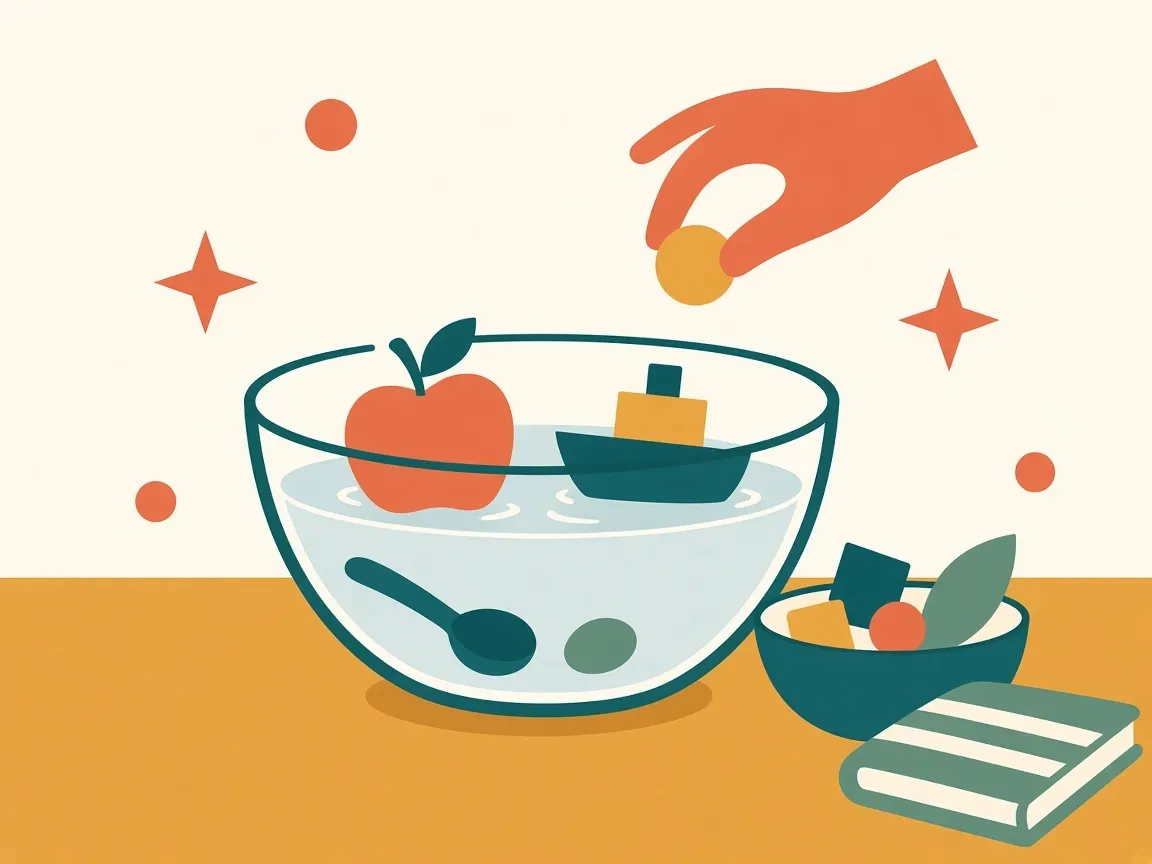
Try it tonight: the sink-or-float experiment
- Fill a large bowl or the sink with water.
- Gather 8 to 10 objects: a spoon, a cork, an apple, a coin, a leaf, a toy boat, a crayon.
- Predict: your child sorts them into "sink" and "float" piles.
- Test: one at a time. Celebrate the surprises.
- Wonder: "Why did the big apple float but the little coin sink?"
- New question: "Can we make the coin float?" (A foil boat is a lovely next step.)
This is guided play in action, an idea explored in our pillar guide to learning through play.
Curiosity by age
| Age | What curiosity looks like | Feed it with |
|---|---|---|
| 1–3 years | Touching, tasting, dropping things to see what happens | Safe objects to explore, naming everything, cause-and-effect toys |
| 3–5 years | "Why?" on repeat, big theories about the world | Kitchen experiments, nature walks, "what if" questions |
| 6–8 years | Collecting, how-things-work questions, first research | Library trips, simple experiments, taking things apart (safely) |
| 9–12 years | Deep interests, debates, testing adults' answers | Projects of their choice, documentaries watched together, real tools |
Curiosity killers to avoid
- Rushing every answer. Instant answers, especially from a screen, can end the thinking too soon. Our guide to screen time by age has ideas for using screens to spark questions rather than replace them.
- Only praising right answers. Praise good guesses, careful testing and persistence too.
- Over-scheduling. Children need unstructured time to notice things.
- Doing it for them. Letting kids handle real tasks, like those in our chores by age guide, builds the confidence to explore.
Curiosity also feeds kindness: a child who wonders about other people is on the way to empathy, which we explore in teaching kindness.
Frequently asked questions
My child asks why all day long. Is that normal?
Yes, and it's a good sign. Research on children's questions shows they use them to gather information they need, and that they often keep asking when an answer doesn't satisfy them. It is learning in action, even when it is tiring.
What should I say when I don't know the answer?
Say so, happily: 'I don't know. How could we find out?' Then look it up together, ask someone, or test it. You model that not knowing is the start of learning, not something to hide.
Do educational apps build curiosity?
Some can help, especially when you use them together. But for young children, hands-on exploration and conversation with a caring adult matter most. Choose apps thoughtfully and keep them as one ingredient, not the main course.
Related reading
Sources
- Chouinard MM. Children's questions: a mechanism for cognitive development. Monographs of the Society for Research in Child Development. 2007;72(1).
- Kidd C, Hayden BY. The Psychology and Neuroscience of Curiosity. Neuron. 2015;88(3):449-460.
- Center on the Developing Child, Harvard University. Serve and Return.
- Weisberg DS, Hirsh-Pasek K, Golinkoff RM, Kittredge AK, Klahr D. Guided Play: Principles and Practices. Current Directions in Psychological Science. 2016;25(3):177-182.