
Self-Care Skills for Kids by Age: Raising an Independent Child, Step by Step
Independence isn't about pushing children to grow up fast. It's about giving them real chances to do things for themselves, with patience and the right support.
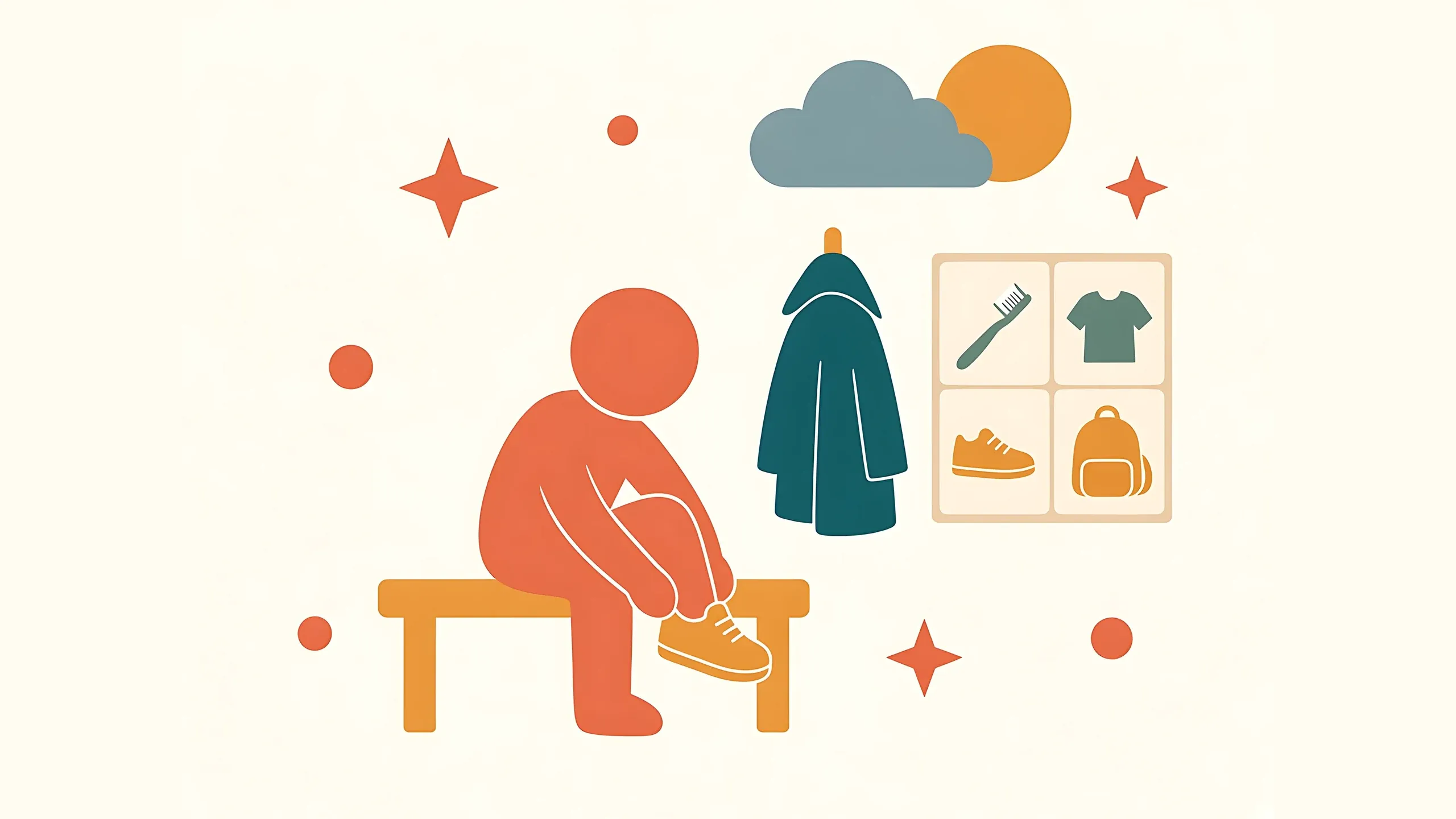
Children become independent by doing real things for themselves, a little at a time, with an adult who teaches, waits and steps back. The trick is to match the task to their age, break it into tiny steps, and resist the urge to rescue, especially on days when you're not in a hurry.
Try tonight: the 60-second version
- Pick one skill your child is nearly ready for: putting on pyjamas, brushing teeth, packing a bag.
- Show it slowly once, without talking much.
- Let them try while you sit on your hands. Count to 20 before helping.
- Help with the hardest step only, then let them finish.
- Notice the effort: "You did up three buttons all by yourself."
Why independence matters
When children do things for themselves, they practise planning, memory, focus and persistence: the executive function skills that Harvard's Center on the Developing Child calls the brain's "air traffic control". Their activities guide suggests everyday tasks and routines are some of the best ways to build them.
Autonomy plus structure. Researchers Wendy Grolnick and Eva Pomerantz highlight an important distinction. Controlling parenting (pressure, guilt, doing it for them) tends to backfire. But providing structure, meaning clear expectations, predictable routines and help when needed, combined with autonomy support (choices, encouragement), helps children become capable and confident.
Pitching in. Barbara Rogoff's research in many cultures shows that children learn deeply when they're included in real family work, not just given separate "children's activities".
The Montessori example. Montessori classrooms emphasise practical life skills like pouring, buttoning and tidying. In a study published in Science, Angeline Lillard and Nicole Else-Quest found that children who attended a public Montessori school performed better on several measures, including executive function, than those in other schools. You don't need Montessori to borrow the idea: low hooks, small jugs and step stools work at home.
Say this instead of that
| Instead of… | Try… |
|---|---|
| "Here, let me do it, we're late." | "Tonight we'll practise shoes, so tomorrow you'll be faster." |
| "You're doing it wrong." | "Nearly! Try putting the tag at the back." |
| "Go and get dressed." (repeated five times) | "What's next on your morning chart?" |
| "Good boy!" | "You did the zip all by yourself. That's tricky!" |
| "You're too little for that." | "Let's try it together first." |
Age by age: self-care skills
These are typical ranges, not deadlines. The CDC's developmental milestones are a helpful general guide.
| Age | Skills many children are learning |
|---|---|
| 2–3 | Feeding with a spoon, drinking from an open cup, pulling off socks and shoes, washing hands with help, putting toys in a box |
| 3–4 | Putting on loose clothes and coats, using a fork, brushing teeth with help, toileting with reminders, pouring from a small jug |
| 4–5 | Dressing with help for fastenings, serving food, wiping the table, washing face, choosing clothes |
| 5–6 | Buttons and zips, packing a school bag, making a simple snack, tidying their room with a checklist |
| 7–9 | Showering with reminders, making their bed, preparing breakfast, managing homework materials |
| 10–12 | Laundry with guidance, simple cooking, managing their own schedule, packing for trips |
Myth vs fact
- Myth: Independence means leaving children to figure it out. Fact: Children need structure and teaching, then gradual handover (Grolnick and Pomerantz, 2009).
- Myth: It's kinder to do things for them. Fact: Doing things for children that they can do themselves can undermine confidence.
- Myth: They'll learn on their own when they're older. Fact: Skills build on each other, and early practice makes later steps easier.
- Myth: Independence must be perfect. Fact: Lopsided pyjamas are a win. Effort counts more than results.
One morning, step by step
Leo (3) usually waits for Mum to put on his shoes. This Saturday, there's no rush.
- Set it up. Velcro shoes, a low bench, plenty of time.
- Show once. Mum puts on her own shoe slowly: "Open the strap, foot in, pull the strap, press."
- Hand over. "Your turn." Leo pushes his foot in, the tongue folds under. He frowns.
- Wait. Mum crouches nearby, coat over her arm, and says nothing. Leo tries again.
- Help with the trickiest part. Mum holds the back of the shoe so Leo's heel slides in. Leo presses the strap himself.
- Notice it. "You did the strap all by yourself!" Leo beams and does the other one alone.
- Practise again. By Thursday, Leo's shoes are on before Mum's coat.
Your independence checklist
- ☐ Hooks, cups and step stools are at my child's height
- ☐ We have a picture checklist for morning and bedtime
- ☐ I teach new skills when we're not in a rush
- ☐ I break tasks into small steps
- ☐ I wait before helping and help only with the hard part
- ☐ My child has real jobs in the family
- ☐ I accept "good enough" rather than perfect
- ☐ I notice effort and progress out loud
If this doesn't work
- Your child refuses to try. Offer choices ("Red shirt or blue?") and make it playful. Race the timer or the toy bear.
- Mornings are a battle. Use a picture chart and prepare the night before. See calm morning routine.
- Your child gives up quickly. Praise the process and keep steps tiny. See how to praise kids.
- You want ideas for household jobs. See chores for kids by age.
- Mealtimes are also a struggle. Let your child serve themselves. See picky eating.
- You want to connect independence with money skills. See teaching kids about money by age.
- You want to learn more about learning by doing. See learning through play.
When to talk to a professional
If your child is well behind on several self-care skills for their age, has difficulty with fine motor tasks such as holding a spoon or crayon, is very sensitive to clothing textures, or loses skills they once had, talk to your doctor or health visitor. An occupational therapist can assess and help.
Bedtime helpers
The Boat Made of Paper shows Kai learning from his grandmother to "fold slow and fold true", a lovely image for patient practice. The Lantern Keeper's Apprentice follows Teo as he takes on a real job and learns what responsibility means.
Frequently asked questions
At what age should my child dress themselves?
Many children can put on some clothes, like loose trousers or a jacket, around age three, and manage most dressing except tricky fastenings by five or six. Every child is different, so focus on the next small step.
My child can do it but wants me to do it. What should I do?
Sometimes children want closeness, not help. Offer a middle path: 'I'll do the first sock, you do the second.' On calm days, gently encourage more independence.
Isn't it faster if I just do it?
In the short term, yes. But time invested now pays back later. Teach new skills on weekends or calm evenings, not on rushed school mornings.
How do I stop nagging?
Use picture checklists, routines and natural consequences. Point to the chart instead of repeating instructions: 'What's next on your list?'
What if my child isn't meeting self-care milestones?
Children develop at different rates. If your child is well behind on several skills, or struggles with fine motor tasks, talk to your doctor or health visitor. An occupational therapist can help.
Related reading
- Teaching Kids About Money by Age: Pocket Money, Saving and Smart Choices
- Picky Eating in Kids: A Calm, No-Pressure Plan That Actually Works
- How to Praise Kids: Why "Good Job" Backfires and What to Say Instead
- Age-Appropriate Chores for Kids: A Simple List From Toddlers to Tweens
- A Calm Morning Routine for Kids: How to Get Out the Door Without Yelling
- Learning Through Play: A Parent's Guide to Raising Kind, Curious, Capable Kids
Sources
- Rogoff B. Learning by Observing and Pitching In to Family and Community Endeavors: An Orientation. Human Development. 2014;57(2-3):69-81.
- Grolnick WS, Pomerantz EM. Issues and Challenges in Studying Parental Control: Toward a New Conceptualization. Child Development Perspectives. 2009;3(3):165-170.
- Lillard A, Else-Quest N. Evaluating Montessori Education. Science. 2006;313(5795):1893-1894.
- Center on the Developing Child, Harvard University. Enhancing and Practicing Executive Function Skills with Children from Infancy to Adolescence (activities guide).
- Centers for Disease Control and Prevention (CDC). CDC's Developmental Milestones.