Reading Aloud to Kids by Age: How to Make Story Time Count, From Babies to Tweens
Reading aloud is one of the simplest, most powerful things you can do with your child. Here is how to make it richer at every age, in ten minutes a day.
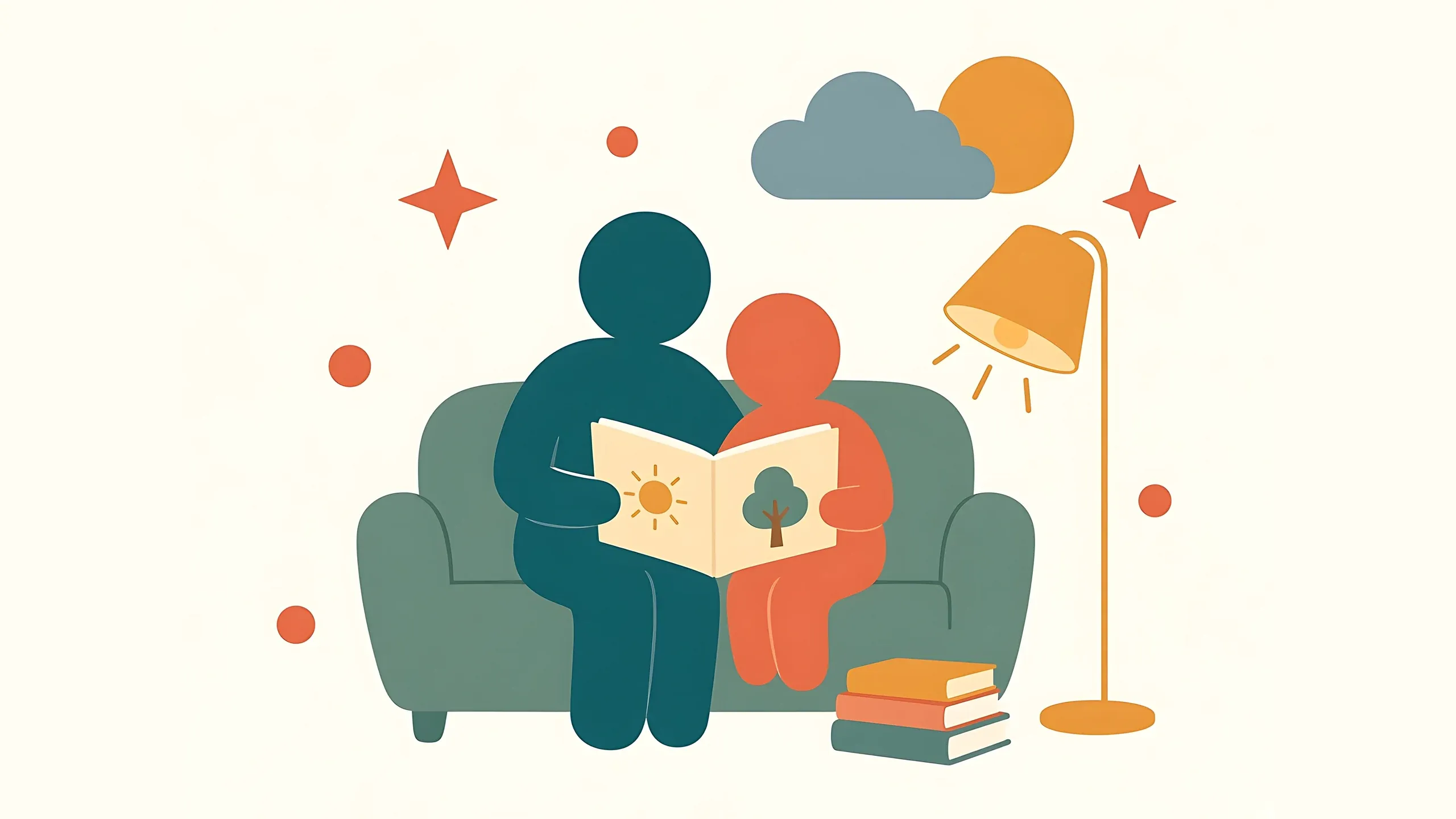
Reading aloud for 10–15 minutes a day is one of the most powerful things you can do for your child's language, imagination and closeness with you, and it's worth doing from birth to well past the age they can read themselves. The secret isn't reading perfectly. It's talking together about the story.
Try tonight: the 60-second version
- Pick a book your child chooses, even if it's the 40th time.
- Pause on one page and ask an open question: "What do you think will happen next?"
- Follow their answer ("Ooh, you think the fox will help? Why?") before reading on.
- Add one new word: "The moon looks enormous, that means really, really big."
- End with a cuddle and one sentence about your favourite part.
What the research says
Start early. In its 2024 policy statement, the American Academy of Pediatrics recommends shared reading from birth through at least kindergarten and calls literacy promotion an essential part of primary care. Programmes like Reach Out and Read give books and guidance to families at check-ups.
Words add up. Jessica Logan and colleagues estimated how many words children hear from picture books. A child read one book a day hears almost 300,000 more words by age five than a child who is never read to. At five books a day, the gap reaches about 1.4 million words.
Stories light up the brain. John Hutton and colleagues scanned the brains of three- to five-year-olds while they listened to stories. Children from homes with more reading showed greater activation in brain areas linked to understanding meaning and forming mental images.
Talking beats reading straight through. In a classic study by Grover Whitehurst and colleagues, parents of toddlers were coached to ask questions, expand on answers and praise their child's contributions during reading (now called dialogic reading). After just one month, children's expressive language was several months ahead of a comparison group. A meta-analysis by Suzanne Mol and colleagues confirmed that dialogic reading boosts vocabulary, especially for younger children.
The PEER trick (dialogic reading made easy)
- Prompt: ask a question. "What's that?"
- Evaluate: respond warmly. "Yes, it's a lighthouse!"
- Expand: add a little more. "A tall lighthouse that shines a light for boats."
- Repeat: invite them to say it. "Can you say lighthouse?"
Say this instead of that
| Instead of… | Try… |
|---|---|
| "Shh, just listen." | "What do you notice on this page?" |
| "We've read that one a hundred times." | "Let's read it again, and this time you tell me what happens." |
| "Sit still!" | "You can turn the pages. Show me the next picture." |
| "That's wrong, it's a duck." | "It does look like a bird! It's a duck. What sound does a duck make?" |
| "You can read alone now." | "Want to take turns, a page each? Or shall I read the next chapter?" |
Age by age: what to read and how
| Age | What to read | How to read |
|---|---|---|
| Babies (0–12 months) | Board books, high-contrast pictures, rhymes, songs | Hold them close, use a sing-song voice, let them touch and mouth books |
| Toddlers (1–3) | Repetitive, rhyming, lift-the-flap, naming books | Point and name, ask "Where's the…?", let them finish rhymes |
| Preschool (3–5) | Picture books with a story, feelings books, simple non-fiction | Dialogic reading, predict, link to their life ("Remember when you…?") |
| Early school (5–8) | Longer picture books, early chapter books, poems, fact books | Read above their reading level, talk about characters and choices |
| Tweens (8–12) | Novels, graphic novels, series, books about real issues | Read aloud a chapter a night, take turns, discuss big themes |
Myth vs fact
- Myth: Babies are too young for books. Fact: The AAP recommends reading from infancy. It builds language and connection.
- Myth: Once children can read, they don't need to be read to. Fact: Listening comprehension stays ahead of reading for years.
- Myth: Only "educational" books count. Fact: Comics, picture books, rhymes and silly stories all build language and joy.
- Myth: You must read every word on every page. Fact: Chatting about pictures counts. Talking is where much of the learning happens.
One bedtime, step by step
Omar (2) brings you his favourite book about a bear for the fifth night in a row.
- Settle in. Lights low, phone in another room. Omar snuggles into your arm.
- Let him lead. He turns pages, sometimes two at once. You go with it.
- Ask, then wait. On the bear's page: "Who's this?" Omar points: "Bear!" You expand: "A sleepy brown bear. He's yawning, like this!"
- Let him finish. At the familiar line, you pause. Omar shouts the last word. You both laugh.
- Connect to his life. "The bear has a blanket. Where's your blanket?" He grabs it proudly.
- Close the book calmly. "The end. Goodnight, bear. Goodnight, Omar." It becomes part of a predictable bedtime routine.
Your reading-aloud checklist
- ☐ We read together most days, even for 10 minutes
- ☐ Books are within my child's reach at home
- ☐ My child chooses at least some of the books
- ☐ I ask questions and let my child talk about the story
- ☐ We visit the library regularly
- ☐ I keep reading aloud even after my child can read alone
- ☐ Screens are off during story time
If this doesn't work
- Your toddler wanders off. Keep reading while they play nearby. They're still listening. Try shorter books.
- Your child resists bedtime reading. Move story time to after a bath or breakfast instead.
- Your school-age child "hates reading". Try audiobooks, comics or books about their passions. Interest beats level. See how to encourage curiosity.
- You feel self-conscious reading aloud. Your child doesn't need a performance, just your voice. Voices get better with practice.
- You want more ideas for learning together. See learning through play and why boredom is good for kids.
- Your child worries about starting school. Books about first days help. See starting school and transitions.
Where this fits
Reading together is also a perfect moment for process praise ("You remembered what happens next!") as explained in how to praise kids.
Bedtime helpers
Our illustrated bedtime stories were written to be read aloud. The Moon Who Lost Her Glow is a cosy adventure about small kindnesses, and Pip and the Very Big Question follows a tiny hedgehog's curiosity about where the wind goes, perfect for asking "What do you think?" on every page.
Frequently asked questions
When should I start reading to my baby?
From birth. The American Academy of Pediatrics recommends reading aloud to children beginning in infancy. Babies benefit from your voice, the rhythm of language and the closeness, long before they understand the words.
My child can read now. Should I stop reading aloud?
Please don't. Children can understand much more complex stories than they can read alone. Reading aloud to school-age children builds vocabulary, comprehension and a love of books, and keeps a precious connection going.
What if my toddler won't sit still for a story?
That's normal. Keep it short, let them turn pages, point and chat about pictures, and don't worry about finishing the book. A few happy minutes beat a long battle.
Does reading the same book over and over help?
Yes. Repetition helps young children learn new words, predict what comes next and feel confident. Asking questions on the tenth reading makes it even richer.
How much reading aloud is enough?
Even one book a day adds up. One study estimated that children read one picture book daily hear almost 300,000 more words by age five than children who are never read to.
Related reading
- "I'm Bored!" Why Boredom Is Good for Kids and What to Do Instead of Fixing It
- How to Praise Kids: Why "Good Job" Backfires and What to Say Instead
- Starting School: How to Help Your Child With the Transition (and Goodbye Tears)
- Bedtime Routine for Kids: A Simple, Science-Backed Plan for Easier Nights
- How to Encourage Curiosity in Children: Turning Why Into a Habit
- Learning Through Play: A Parent's Guide to Raising Kind, Curious, Capable Kids
- How to Read Bedtime Stories Aloud: A Parent's Guide to Story Time That Works
Sources
- Klass P, Miller-Fitzwater A, High P, et al.; Council on Early Childhood. Literacy Promotion: An Essential Component of Primary Care Pediatric Practice (policy statement). Pediatrics. 2024;154(6):e2024069090.
- Logan JAR, Justice LM, Yumuş M, Chaparro-Moreno LJ. When Children Are Not Read to at Home: The Million Word Gap. Journal of Developmental & Behavioral Pediatrics. 2019;40(5):383-386.
- Hutton JS, Horowitz-Kraus T, Mendelsohn AL, DeWitt T, Holland SK. Home Reading Environment and Brain Activation in Preschool Children Listening to Stories. Pediatrics. 2015;136(3):466-478.
- Whitehurst GJ, Falco FL, Lonigan CJ, et al. Accelerating language development through picture book reading. Developmental Psychology. 1988;24(4):552-559.
- Mol SE, Bus AG, de Jong MT, Smeets DJH. Added Value of Dialogic Parent–Child Book Readings: A Meta-Analysis. Early Education and Development. 2008;19(1):7-26.
- Reach Out and Read. Evidence-based early literacy programme.