
Teaching Kids About Money by Age: Pocket Money, Saving and Smart Choices
Children start learning about money long before they can count it. Small, everyday chances to choose, wait and share build habits that last a lifetime.
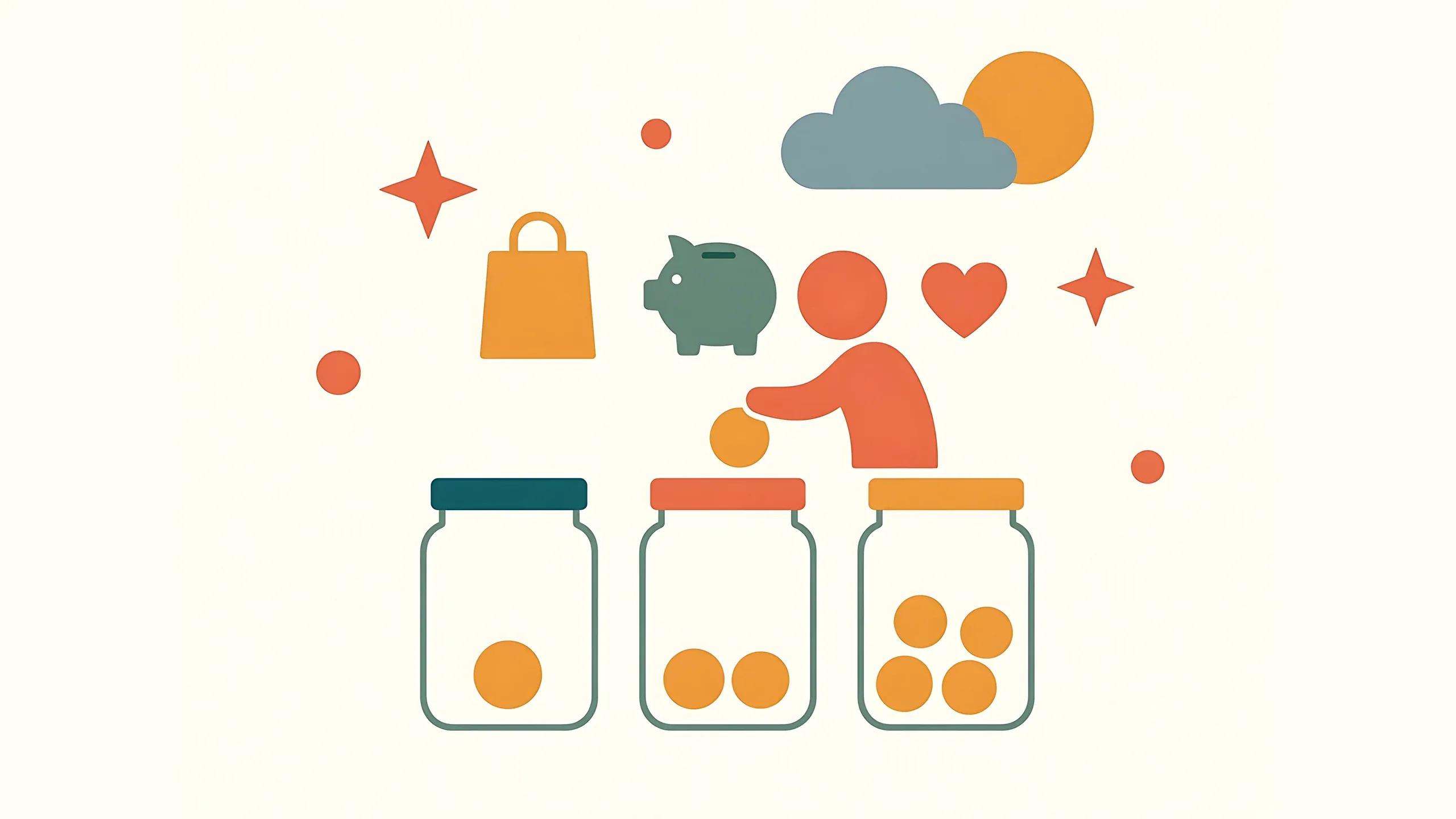
Children learn about money the same way they learn everything else: by watching you, by practising with small amounts, and by making a few mistakes while the stakes are low. Start with simple choices in the preschool years, add regular pocket money when they can count, and gradually hand over more decisions as they grow.
Try tonight: the 60-second version
- Set up three jars: Spend, Save and Share. Label them with pictures for little ones.
- Next time you shop, let your child pay with coins or a card and wait for the change or receipt.
- Think out loud about one money decision: "I'd like that jacket, but I'm saving for our holiday, so I'll wait."
- Pick one savings goal together and draw a simple chart to colour in.
How money skills develop
The US Consumer Financial Protection Bureau's Money as You Grow framework describes three building blocks that develop across childhood and adolescence:
- Executive function (early childhood): planning, focusing, self-control, waiting.
- Financial habits and norms (middle childhood): rules of thumb and attitudes, such as "we save some of everything" or "we compare prices".
- Financial knowledge and decision-making (teens and beyond): budgeting, interest, research and bigger choices.
That means a four-year-old learning to wait for a turn is already doing money education. Harvard's Center on the Developing Child offers age-by-age activities to practise these executive function skills, from games like Simon Says to planning projects.
What about willpower? The famous marshmallow test suggested that children who could wait for two treats did better later in life. But when Tyler Watts and colleagues repeated it with a larger, more diverse group, the link was much weaker once family background was considered. The takeaway: self-control isn't destiny. It grows with practice, and with a stable environment where waiting actually pays off.
Learning by doing. Psychologist Barbara Rogoff's research shows that children learn deeply by observing and pitching in to real family activities, which includes shopping, budgeting and comparing prices.
Say this instead of that
| Instead of… | Try… |
|---|---|
| "We can't afford that." | "That's not in our plan this month. Want to add it to your wish list?" |
| "Money doesn't grow on trees!" | "We work to earn money, and we choose carefully how to use it." |
| "No, put it back!" | "You've got £5 in your spend jar. Is this what you want to use it on?" |
| "Fine, I'll buy it for you." (after whining) | "You can save for it. How many weeks do you think it'll take?" |
| "Don't worry about money, that's for grown-ups." | "Here's how we decide what to buy for dinner." |
Age by age: money skills
| Age | What they can learn | Try this |
|---|---|---|
| 3–5 | Money is exchanged for things, choices, waiting | Play shop, let them hand money to the cashier, practise waiting games |
| 6–8 | Coins and notes, saving for a goal, simple choices | Regular pocket money, three jars, a savings chart, let them make small mistakes |
| 9–11 | Comparing prices, budgeting, needs vs wants, advertising | Give a small budget for a family outing, compare prices online, talk about ads |
| 12+ | Bank accounts, digital money, earning, longer-term goals | Open a youth account, discuss digital payments and in-app purchases, encourage small earning projects |
Myth vs fact
- Myth: Children are too young to understand money until they're teens. Fact: CFPB research suggests key building blocks are forming in early and middle childhood.
- Myth: Talking about money with kids is inappropriate. Fact: Age-appropriate conversations build healthy, less anxious attitudes.
- Myth: Rescuing kids from bad purchases protects them. Fact: Small mistakes are cheap, powerful lessons.
- Myth: The marshmallow test proves self-control is fixed. Fact: Later research shows the picture is more complex (Watts and colleagues, 2018).
One shopping trip, step by step
Ruby (7) gets £3 a week in pocket money. She has £8 saved. At the market, she spots a sparkly hair clip for £4 and a big kite for £12.
- Let her lead. "You've got £8. What would you like to do?"
- Help her think. "If you buy the clip, you'll have £4 left. How many weeks until you could get the kite?" Ruby counts: "Three more weeks."
- Don't decide for her. She buys the clip. You say nothing about the kite.
- Let her pay. She counts out the coins herself and waits for change, proudly.
- Check in later. A week later, the clip is lost. Ruby is upset. You empathise: "That's really disappointing."
- Reflect together. "Next time, do you want to buy straight away or wait a bit?" Two months later, she's saved for the kite, and it means more because it was hers.
Your family money checklist
- ☐ My child gets a regular, predictable amount of pocket money
- ☐ We use spend, save and share jars or accounts
- ☐ My child has a savings goal and a way to track it
- ☐ I talk out loud about money decisions
- ☐ My child pays at the shop sometimes
- ☐ We talk about ads and in-app purchases
- ☐ I let my child make small money mistakes
- ☐ We give some money or time to others
If this doesn't work
- Your child spends everything instantly. Try a short rule: half goes in Save before anything else. Increase the amount slowly.
- Constant "Can I have it?" pressure. Use a wish list and wait a week before any purchase. Wants often fade.
- In-game purchases are the issue. Set controls and talk about how apps are designed to make us spend. See screen time by age.
- You want them to earn too. Link to real household jobs. See chores for kids by age.
- You want more hands-on learning. Play shop and board games with money. See learning through play.
- Your child takes things for granted. See teaching kids gratitude.
Where this fits
Money skills grow together with independence, as in self-care skills by age, and with the patience children build through unstructured time, as in why boredom is good for kids.
Bedtime helpers
Grandpa's Box of Ordinary Things is about a button, a key and a seashell that are worth very little money but hold priceless family stories. It's a lovely way to talk about what things are really worth.
Frequently asked questions
At what age should children get pocket money?
Many families start between ages five and seven, when children can count and understand that money runs out. What matters most is consistency and letting them make real choices with it.
How much pocket money should I give?
There's no single right amount. Some families use a simple rule, such as a small sum per year of age per week. Choose an amount you can keep up and that lets your child save for something small within a few weeks.
Should pocket money be tied to chores?
Families differ. Many experts suggest keeping basic household help separate (everyone pitches in because they live there) and offering optional paid jobs for extra money.
What should I do when my child wastes their money?
Let them. A small regret at seven is a cheap lesson. Empathise ('It's disappointing when a toy breaks so quickly') and resist the urge to replace it.
Is the marshmallow test about money?
Not directly, but it's often linked to saving. A large replication by Watts and colleagues found that early delay of gratification was related to later achievement, but much less strongly than originally thought once family background was taken into account. Practice and environment matter.
Related reading
- How to Teach Kids Gratitude (Without Forcing "Say Thank You")
- Self-Care Skills for Kids by Age: Raising an Independent Child, Step by Step
- "I'm Bored!" Why Boredom Is Good for Kids and What to Do Instead of Fixing It
- Age-Appropriate Chores for Kids: A Simple List From Toddlers to Tweens
- Learning Through Play: A Parent's Guide to Raising Kind, Curious, Capable Kids
- Screen Time for Kids by Age: What the Guidelines Say and a Family Plan That Works
Sources
- Consumer Financial Protection Bureau. Money as You Grow.
- Watts TW, Duncan GJ, Quan H. Revisiting the Marshmallow Test: A Conceptual Replication Investigating Links Between Early Delay of Gratification and Later Outcomes. Psychological Science. 2018;29(7):1159-1177.
- Center on the Developing Child, Harvard University. Enhancing and Practicing Executive Function Skills with Children from Infancy to Adolescence (activities guide).
- Rogoff B. Learning by Observing and Pitching In to Family and Community Endeavors: An Orientation. Human Development. 2014;57(2-3):69-81.